


Optical waveplates (also called wave plates or retarder plates) are transparent plates with a carefully chosen amount of birefringence. They are mostly used for manipulating the polarization state of light beams. A waveplate has a slow axis and a fast axis, both being perpendicular to the beam direction, and also to each other. The phase velocity of light is slightly higher for polarization along the fast axis. The designed value of optical retardance (difference in phase delay for the two polarization directions) is achieved only in a limited wavelength range (see below) and in a limited range of incidence angles.
Common Types and Applications
The most common types of waveplates are quarter-wave plates (λ/4 plates) and half-wave plates (λ/2 plates), where the difference of phase delays between the two linear polarization directions is π/2 or π, respectively, corresponding to propagation phase shifts over a distance of λ / 4 or λ / 2, respectively.
Some important cases are:
When a light beam is linearly polarized, and the polarization direction is along one of the axes of the waveplate, the polarization remains unchanged.
When the incident polarization does not coincide with one of the axes, and the plate is a half-wave plate, then the polarization stays linear, but the polarization direction is rotated. For example, for an angle of 45° to the axes, the polarization direction is rotated by 90°.
When the incident polarization is at an angle of 45° to the axes, a quarter-wave plate generates a state of circular polarization. (Other input polarizations lead to elliptical polarization states.) Conversely, circularly polarized light is converted into linearly polarized light.
Within a laser resonator, two quarter-wave plates around the gain medium are sometimes used for obtaining single-frequency operation (→ twisted-mode technique). Inserting a half-wave plate between a laser crystal and a resonator end mirror can help to reduce depolarization loss. The combination of a half-wave plate and a polarizer allows one to realize an output coupler with adjustable transmission.
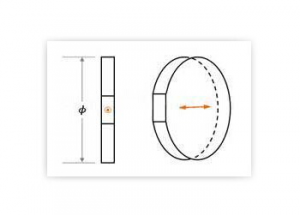
Many waveplates are made of crystalline quartz (SiO2), as this optical material exhibits a wide wavelength range with very high transparency, and can be prepared with high optical quality. Other possible materials (to be used e.g. in other wavelength regions) are calcite (CaCO3), magnesium fluoride (MgF2), sapphire (Al2O3), mica (a silicate material), and some birefringent polymers.
Hangzhou Shalom EO is a leading supplier of crystals, optics, OEM components products, a wide range of the products are offered:
• Crystals, optics and components for laser systems and applications;
• IR lenses, windows and optics for thermal imaging cameras and applications;
• Scintillation crystals and components for X-ray, nuclear ray detection;
• SAW crystals and wafers, Sapphire and other crystal and optics products for semiconductor, industrial, medical, scientific and research applications.