


Correction of Spherical Aberrations:
Spherical aberration is the intrinsic failure existing in all spherical lenses and has nothing to do with production tolerances, even a spherical lens manufactured with perfect precision will still exhibit spherical aberrations. It is a phenomenon when light rays that strike a spherical surface off-center are refracted or reflected more or less than those that strike close to the center instead of being focused onto the theoretical focal point, the consequence is a blurring of the spot. Replacing spherical lenses with aspheric lenses is an excellent measure to correct spherical aberration. As shown in Figure 3, the aspheric lens brings the off-center light rays focused onto the focal point, creating a crisp spot. By adjusting the conic constant and aspheric coefficient, any aspheric lens can be optimized to minimize aberrations.
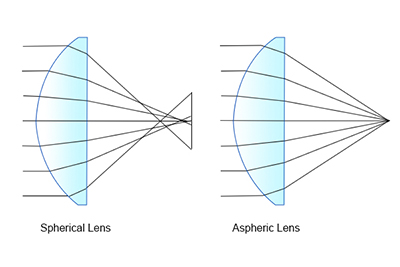
Figure 1. illustrates the correction of spherical aberration using an aspheric lens
Other Advantages of Aspheric Lens
Correction of Chromatic Aberrations:
In general, due to the symmetric shape of the spherical surface of the traditional spherical lens, when a light source composed of different wavelengths is incident, the light will encounter different refractive indices, which will cause chromatic aberration. Aspheric lenses can achieve the correction of chromatic aberration by designing asymmetric curvature radii, so that light of different wavelengths has the same refractive index in the lens, thereby reducing chromatic aberration.
Correction of Image Field Distortion:
Distortion is a variation of the magnification with the field angle, causing changes in the shapes of the image according to the actual object. Distortion has no impact on the image qualities but affects the similarities of the image to the object. When a lens is forming an image, it will deform or distort the objects at the edge of the image, Aspheric lenses can be designed with asymmetric curvature radii so that lights at different positions have the same refractive index in the lens, which can better correct image field distortion or distortion.
Achieving Larger Numerical Aperture and Higher Resolution
In the case of a spherical lens, a common measure to obtain the desired resolution is to reduce the numerical aperture (increase the f/#) of the lens group. The result is a trade-off of the loss of light throughput. Aspherical lenses allow the achievement of high image resolution without sacrificing the numerical aperture.
Simplification of Optical System
A single aspheric lens could substitute a dozen of spherical lenses because the former offers manifold correction of optical aberrations at a time. This permits the simplification of the system, leading to a reduction in production coat. Furthermore, in application contexts where capacity and weight might be of concern. aspheric lens is far more advantageous than spherical lenses. For instance, aspheric lenses could be used to downscale modern fluorescence microscopes, projectors, or lasers. the use of aspheric lenses has played a decisive role in the aerospace field with its benefits of weight-saving and downscaling. By reducing weight, fuel consumption can be reduced when sending Earth observation satellites.