

Technical Introduction of Cr:YAG
Product Name: Chromium-doped Yttrium Aluminum Garnet Crystals
chemical formula: Cr : YAG ( Cr4 + : Y3Al5O15 )
Material: Crystalline material (Composition: Yttrium 40.9%, Aluminum 20.6%, Oxygen 36.7%, Chromium: 1.8%)
Product images:
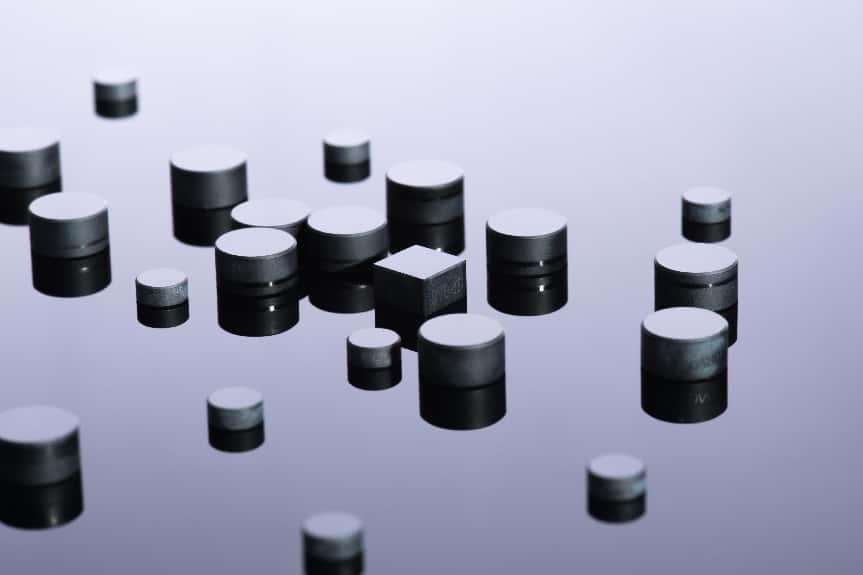
- Product Introduction:
Chromium-doped yttrium aluminum garnet (Cr:YAG) crystal is a solid-state Q-switching crystal for lasers with excellent saturated absorption characteristics. Its parent material is YAG crystal (yttrium aluminum garnet), and near-infrared absorption centers are introduced by doping with tetravalent chromium ions (Cr⁴⁺). It can be widely used as a passive Q-switching element in pulsed laser systems. Cr:YAG crystal has stable and reliable chemical properties, a long service life, good thermal conductivity, and can withstand high thermal loads. Furthermore, Cr:YAG crystal has a high loss threshold, allowing it to withstand high laser energies without damage.
This product is made by reacting and growing chromium-doped yttrium aluminum garnet crystals in a high-temperature environment (within a high-temperature growth furnace). Yttrium aluminum garnet crystals are often made into rods or sheets, and the polished surfaces require precision polishing and coating .
- Working principle:
The working principle of chromium-doped yttrium aluminum garnet (Cr:YAG) crystal as a passive Q-switcher is based on its saturable absorption characteristics. When the intracavity light intensity is weak, the Cr:YAG crystal has a high absorption rate for the laser, resulting in a low Q value and continuous accumulation of inverted particles. As the intracavity light intensity increases, the Cr:YAG crystal gradually saturates, its absorption rate decreases, and its transmittance increases, leading to an increase in the Q value and thus establishing a Q-switching pulse.
Cr:YAG crystals are often used in combination with neodymium-doped yttrium aluminum garnet crystals (Nd:YAG) to form the required pulsed laser system. Bonding Cr:YAG and Nd:YAG together can directly output pulsed laser.
- Production process:
- Material preparation: Chromium dopant is uniformly mixed with yttrium oxide and alumina raw materials, and then placed in a tungsten or platinum crucible for Czochralski crystal growth in an argon or micro-oxygen environment. To ensure the stability of the valence state of Cr⁴⁺, the oxygen partial pressure and thermal gradient must be strictly controlled.
- Preliminary processing: After the grown crystal ingots undergo quality inspection, they are cut into standard-sized crystal rods or wafers to ensure that there are no optical defects such as cracks, bubbles, or impurities.
- Precision machining: CNC grinding machines are used for orientation, milling, fine grinding and double-sided polishing, the surface finish can reach λ/10 or higher, and the surface roughness Ra < 5 Å.
- Surface treatment: Anti-reflective coatings or high-reflective coatings with different initial transmittances can be deposited on the crystal surface according to customer needs, and anti-laser damage coatings can be customized to improve service life and stability.
- Application areas:
This crystal is widely used in laser systems, such as passive Q-switched pulse output in laser marking systems, compact Q-switching modules in laser rangefinders, pulse control for passive modulation in medical lasers, and nanosecond laser source generation in scientific research and teaching platforms.
Tags: Cr:YAG crystal