

Introduction to Lithium Niobate (LiNbO3) Substrates
Product Introduction:
Lithium niobate substrates are made of lithium niobate crystals. Lithium niobate crystals, abbreviated as LN, belong to the trigonal system and have an ilmenite-type (distorted perovskite-type) structure. Lithium niobate crystals possess multiple properties, including piezoelectric, ferroelectric, optoelectronic, nonlinear optical, and thermoelectric properties.
Lithium niobate crystals are produced using the Czochralski method, where lithium carbonate and niobium pentoxide are placed in a platinum crucible and grown along the (001) axis. To obtain high-quality, colorless, transparent cylinders, an appropriate electric field must be applied until the temperature of both end faces in both directions of crystal growth is slightly above the Curie temperature. After the crystal is formed, it is cooled to room temperature to produce the lithium niobate crystal.
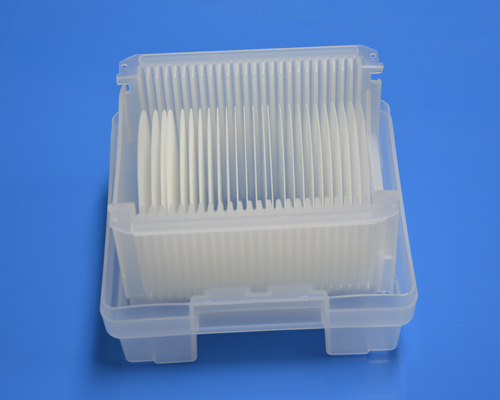
Physical and chemical properties of lithium niobate crystals |
|
Crystal name |
lithium niobate crystal |
Crystal structure |
Three-party |
Lattice constant |
a=0.5147 nm, c=1.3856 nm |
Melting point |
1240℃ |
Curie temperature |
1140℃ |
density |
4.659 g/cm3 |
Mohs hardness |
5 mohs |
Spectral transmission wavelength |
0.4-2.9um |
Refractive index |
n0=2.2961, ne=2.2105(λ=600 nm) |
Dielectric constant |
ε=44, ε=29.5, ε=84, ε=30 |
Nonlinear coefficient |
d31=-6.3×10pm/V, d22=+3.6×10pm/V, d33=-47×10pm/V |
Electro-optic coefficient |
γ13=γ23=10×10pm/V, γ33=32×10pm/V. Γ22=-γ12=-γ61=6.8×10pm/V |
Spontaneous polarization intensity |
50×10C/cm' |
Spectral transmittance range |
370~5000nm >68% (632.8nm) |
Thermal conductivity |
0.056 W/cm·K |
Coefficient of thermal expansion |
a11=15.4×10E-6/k, a33=7.5×10E-6/k |
Working principle:
Lithium niobate has the characteristics of high sensitivity and fast response, and is suitable for measuring tiny pressure changes. After the lithium niobate crystal is polarized, it has multiple functions such as piezoelectricity, ferroelectricity, and photoelectricity, which makes it show excellent performance in the field of sensors. Lithium niobate (LiNbO₃) is a ferroelectric crystal. Its crystal structure will deform under the action of pressure, causing the charge distribution inside the crystal to change, thereby generating a voltage signal. This effect is reversible, that is, applying voltage can also cause the crystal to deform. By taking advantage of the properties of lithium niobate, pressure sensors can be made, which are widely used in scenarios such as mechanical stress monitoring and chemical reaction pressure control. Accurate measurement is achieved by converting pressure into electrical signals.
Production process:
- Material preparation: The crystal blank was grown by the Czochralski method, and lithium carbonate and niobium pentoxide were used as raw materials to prepare lithium niobate crystals.
- Preliminary processing: The crystal blank is quality inspected. After confirmation of qualification, the crystal is cut according to the design requirements to obtain the required shape and size.
- Precision machining: Milling, grinding, polishing and other precision machining processes are used to ensure that the crystals meet strict geometric tolerances and excellent optical surface quality.
- Surface treatment: Polishing on the polished crystal surface (if coating is required, a vacuum coating machine is needed to coat the required film system (such as anti-reflection film, high reflective film, etc.) on the surface.
Application areas:
Polarized lithium niobate crystals have sensitive piezoelectric properties that can be converted into electrical signals. They are used to manufacture sensors for detecting physical quantities such as pressure and vibration, and in scenarios such as mechanical stress monitoring and chemical reaction pressure control. Accurate measurement is achieved by converting pressure into electrical signals.
Tags: lithium niobate crystal, linbo3 substrate, linbo3 wafer