

Nd:YAG Crystal Properties & Core Applications
Product Name: Neodymium-doped Yttrium Aluminum Garnet (Nd:YAG) Crystal
Simplified chemical formula: Nd:YAG ( Nd: Y 3 Al 5 O 15 )
Material composition: Crystal material ( main components: yttrium 41.2%, aluminum 20.8%, oxygen 37.0%, neodymium 1.0%)
Product images:
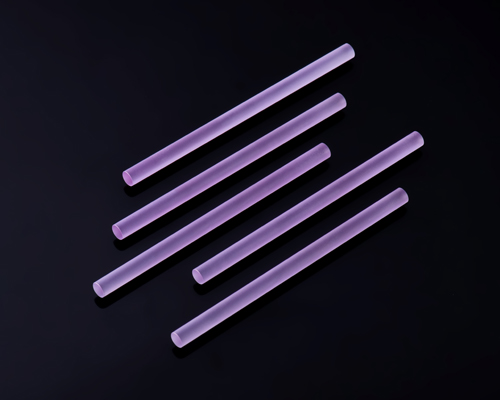
Product Introduction
Neodymium-doped yttrium aluminum garnet (Nd:YAG) crystals are cubic, optically isotropic crystals and are currently one of the most commonly used solid-state laser working media. Their parent material is yttrium aluminum garnet (YAG), which has a cubic crystal structure and stable physical properties. By doping the YAG lattice with trivalent neodymium ions (Nd³⁺), Nd:YAG crystals with laser gain characteristics are formed. Modern Nd³+:YAG crystals are the most widely used solid-state laser materials. These crystals are characterized by a relatively narrow gain bandwidth, resulting in high gain efficiency and a low lasing threshold. Nd:YAG crystals also exhibit excellent thermal and mechanical properties. High-quality, large-diameter Nd:YAG crystals can be obtained using the Czochralski method.
a neodymium-doped yttrium aluminum garnet laser crystal grown by reacting chemical raw materials in a high-temperature environment (a high-temperature growth furnace) . Neodymium-doped yttrium aluminum garnet crystals exhibit excellent transparency, high hardness (Mohs hardness up to 8.5), a high melting point (1950°C), and insolubility in water, sulfuric acid, hydrochloric acid, nitric acid, and hydrofluoric acid. When stimulated by a pump light source, they produce laser light, exhibiting high quantum efficiency and a long fluorescence lifetime. They also exhibit excellent thermal creep resistance, isotropy, and high mechanical strength.
characteristics of Nd:YAG crystal :
- Isotropic crystals with cubic symmetry
- High thermal conductivity
- Use Czochralski method to obtain large diameter and high optical quality spot
- Broad absorption band around 808 nm and low lasing threshold, matching the emission of AlGaAs laser diodes
YAG crystals are often made into rods or flakes according to requirements, and the light-emitting surface requires precision polishing and coating .
Working principle:
Nd:YAG lasers use Nd3+ as the activating ion. When excited by a laser pump lamp or laser diode (LD), a neodymium-doped yttrium aluminum garnet (Nd:YAG) crystal produces laser radiation at a wavelength of 1064 nm. First, the YAG crystal rod is precision-machined and coated with appropriate optical coatings on both ends. It is then assembled with components such as a high-reflectivity mirror and an output mirror and installed within the laser cavity. When energy is input from a pump source such as a halogen lamp or laser diode, the system produces the desired laser output.
Production process:
- Material preparation: Neodymium-doped high-purity yttrium oxide and aluminum oxide raw materials are placed in a high-temperature growth furnace, and crystal growth is achieved through high-temperature chemical reaction to produce neodymium-doped yttrium aluminum garnet (Nd:YAG) crystal blanks.
- Preliminary processing: The crystal blank is quality inspected. After confirmation of qualification, the crystal is cut according to the design requirements to obtain the required shape and size.
- Precision machining: Milling, grinding, polishing and other precision machining processes are used to ensure that the crystals meet strict geometric tolerances and excellent optical surface quality.
- Surface treatment: The required dielectric film (anti-reflection film or reflective film) is coated on the polished crystal surface as required.
Application areas:
Neodymium-doped yttrium aluminum garnet (Nd:YAG) is the earliest, most famous, and most widely used laser working medium . Due to its many excellent basic properties, Nd:YAG is still commonly used in near- and far-infrared solid-state lasers and their frequency doubling and tripling. It can also be used in diode-pumped all-solid-state micro-lasers, producing red, green, and blue lasers with higher efficiency and greater ease of production than Nd:YVO4. Nd:YAG is also widely used in scientific research, medical, and industrial lasers, such as various rangefinders, laser therapy devices, beauty devices, and laser marking and drilling machines. Nd:YAG is the preferred choice for applications requiring high-power, high-energy, Q-switched, and mode-locked ultrashort pulse lasers .
• Laser marking, drilling, welding and engraving in industrial processing
• Surgical treatment and cosmetic freckle removal in the medical field
• Laser experiments and nonlinear optics research in scientific research
Tags: Nd:YAG Crystal