

Photonics Advancement: from Chirped Mirrors, Super Achromatic Waveplates, to CLBO crystals
Part 1: Opening Session: Aligning Localization Agency Services with the Core Theme of ICLO
Distinguished chairpersons, esteemed colleagues, and fellow researchers of the international optics community. It is a great honor to stand before you today at the 22nd International Conference Laser Optics (ICLO 2026) here in Saint Petersburg. My name is representing C-Component, and as the official distributor of Shalom Electro-optics Technology (Shalom EO) in the Russian Federation since 2025, we are proud to serve as your direct local partner for high-precision optics and advanced laser crystals.
When analyzing the scientific program of ICLO 2026, we see a clear trajectory toward higher peak powers, shorter pulse widths, broader spectral bands, and shorter wavelengths. Whether you are working on high-power solid-state systems, investigating super-intense light fields, developing advanced laser beam control methodologies, or exploring deep-ultraviolet applications in biomedical photonics, your systems are fundamentally limited by the materials and coatings of your optical components.
Today, we will demonstrate how Shalom EO’s state-of-the-art engineering directly addresses these technological boundaries through three key innovations: complementary chirped mirror pairs for ultrafast dispersion compensation, super achromatic waveplates for multi-octave polarization control, and cesium lithium borate (CLBO) crystals optimized for high-power deep-ultraviolet frequency conversion.
Part 2: Shalom EO Overview & Advanced Manufacturing
Before diving into the specific technologies, let us look at the foundation of our engineering capabilities. Founded in 2010, Shalom EO has established itself over the past two decades as a trusted partner in the global photonics supply chain. Operating an ISO9001-certified manufacturing factory, our team covers the entire pipeline from raw crystal growth and precision shaping to advanced thin-film deposition and metrology.
Our production lines are equipped with industry-leading polishing machinery and advanced thin-film deposition systems. To ensure that our optics perform reliably in demanding scientific applications, we employ rigorous quality control under cleanroom environments. Utilizing Zygo interferometers and high-end spectrophotometers, we verify that every single optic shipped meets strict tolerances, providing an individual measurement report and a 12-month guarantee. For the Russian scientific community, C-Component bridges this world-class manufacturing with local logistics, custom engineering support, and frictionless procurement.
Part 3: Ultrafast Laser Dispersion Compensation: Complementary Chirped Mirror Pairs
Let us turn our attention to the first technology, which is critical for the ICLO sessions on Super-Intense Light Fields and Ultra-Fast Processes and Solid State Lasers: ultrafast pulse dispersion compensation. As we push toward few-cycle pulse generation, chromatic dispersion within optical media acts as the primary barrier. When a femtosecond pulse travels through standard glasses, it experiences a positive Group Delay Dispersion (GDD), broadening the pulse in time and lowering its peak intensity. For pulses under 30 fs, higher-order phase distortions, notably Third-Order Dispersion (TOD), become critical.
To compress these pulses back to their transform limit, we must introduce negative GDD. Chirped mirrors—dielectric Bragg mirrors with spatially varying layer thicknesses of alternating low and high refractive index materials such as SiO2 and Ta2O5—provide a highly compact solution. By forcing longer wavelengths to penetrate deeper into the coating stack before reflection, they introduce the necessary negative group delay.
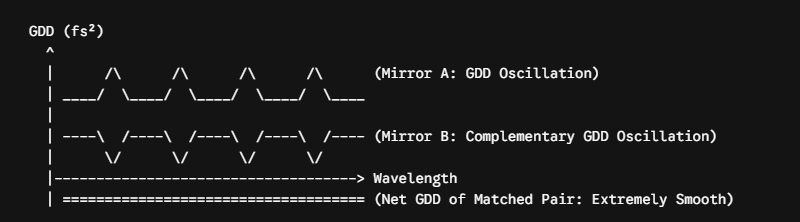
However, a single chirped mirror suffers from a major physical drawback: GDD oscillation. This periodic phase ripple, caused by internal interference between the multilayer interfaces, distorts the spectral phase and degrades the pulse temporal profile.
Shalom EO solves this through our Complementary Chirped Mirror Pairs. Instead of utilizing one coating design, we engineer a pair of mirrors with complementary thin-film profiles. The thin-film structures are designed so that the GDD oscillation peaks of Mirror A align precisely with the valleys of Mirror B. When the pulse reflects alternately between the two mirrors, the dispersion oscillations cancel each other out. This results in an exceptionally smooth and customized net GDD curve with very low TOD, preserving peak power with high reflectance (R>99.9%).
Parameter |
Standard Module |
Custom Pairs |
Central Wavelength |
1000−1060 nm |
266 nm (240−270 nm), |
Reflectance (R) |
R(s+p)/2>99.9% |
R>99.9% (design optimized) |
Typical GDD |
−100 fs2, −500 fs2, −1000 fs2 |
Custom GDD and specific negative GDD slope compensation |
TOD Performance |
Minimal third-order dispersion |
Optimized for high-order compensation specifically to suppress ultrashort pulse distortion |
Laser Systems |
High-power Yb-doped fiber lasers, thin-disk lasers |
Ti:Sapphire oscillators, supercontinuum generation, extreme nonlinear optics |
Part 4: Broadband Polarization Control: Ultra-Achromatic Waveplates
Let us transition to our second technology, which relates directly to the ICLO sessions on Laser Beam Control and Nonlinear Quantum Photonics: broadband polarization control. In systems involving broadly tunable Ti:Sapphire lasers, optical parametric oscillators (OPOs), or femtosecond pulses, managing the polarization state over a wide wavelength band is highly challenging. Standard waveplates made of birefringent materials like Quartz or Magnesium Fluoride (MgF2) exhibit strong chromatic dispersion, meaning their phase retardation changes rapidly with wavelength.
To overcome this wavelength sensitivity, Shalom EO manufactures Super Achromatic Waveplates. The super achromatic waveplate features an upgraded six-plate design. We stack three Quartz single plates and three MgF2 single plates together. Because Quartz and MgF2 have complementary birefringent dispersions, we can align the fast and slow axes of these six plates at mathematically optimized relative angles to ensure that the chromatic dispersion of one material compensates for the other across the entire spectral window.
The result is an exceptionally flat phase retardation over a very broad spectral range, such as 325−1100 nm or 600−2700 nm. For standard laboratory applications, we utilize Norland Optical Adhesive 61 (NOA61), which is MIL-A-3920 compliant, solvent-resistant, and temperature-durable, to cement the plates together with broadband AR coatings. However, for high-power laser systems discussed in the High Power Lasers sessions, organic adhesives present a clear risk of thermal damage. To support high peak power densities, Shalom EO offers alternative zero-order air-spaced waveplates and optically contacted zero-order waveplates, eliminating organic compounds to maximize the laser damage threshold.
Waveplate Category |
Spectral Bandwidth |
Plate Configuration |
Assembly Construction |
Super Achromatic λ/4 |
325−1100 nm / 600−2700 nm |
6-plate structure |
NOA61 cemented, equipped with an external 25.4 mm metal protective mount |
Super Achromatic λ/2 |
310−1100 nm / 600−2700 nm |
6-plate structure |
NOA61 cemented, equipped with an external 25.4 mm metal protective mount |
High Power Zero-Order |
Single Design Wavelength |
2 birefringent multi-order waveplates, with principal axes crossed orthogonally |
Air-spaced or optically contacted epoxyless assembly |
Part 5: Deep-UV & Vacuum-UV Nonlinear Photonics: CLBO Crystals
Let us address our third and perhaps most advanced material innovation, directly aligned with the ICLO sessions on Nonlinear Photonics: Fundamentals and Applications and Biomedical Applications: cesium lithium borate (CsLiB6O10, or CLBO) crystals for deep and vacuum ultraviolet generation.
Generating coherent, high-power ultraviolet radiation below 300 nm presents extreme material challenges. While Beta Barium Borate (BBO) has been a standard choice, it is limited in high-power applications by its massive spatial walk-off angle (4.80∘ at 532 nm SHG), which degrades the output beam profile and limits the conversion efficiency. Furthermore, BBO’s narrow temperature acceptance (4.5∘C⋅cm) makes it highly sensitive to localized thermal loading under high average powers.
CLBO, which crystallizes in a tetragonal structure with space group I4ˉ2d, stands out as a superior alternative. CLBO possesses an effective nonlinear coefficient deff approximately twice that of KDP (1.01 pm/V at 532 nm) and features a shortwave UV cut-off edge at 180 nm, enabling direct frequency quadrupling (FOHG) and quintupling (FIHG) of 1064 nm Nd:YAG lasers.
To model its optical propagation precisely, we utilize the Sellmeier equations at 20∘C (where wavelength λ is in μm) :
no2=2.2104+λ2−0.014240.01018−0.01258λ2(0.1914 μm<λ<2.09 μm)
ne2=2.0588+λ2−0.013630.00838−0.00607λ2(0.1914 μm<λ<2.09 μm)
Through these optical indices, CLBO achieves a spatial walk-off angle of only 1.83∘ at 532 nm SHG, which is less than half that of BBO, ensuring excellent output beam circularity. Its temperature acceptance bandwidth is 9.4∘C⋅cm, more than double that of BBO, making it thermally stable under extreme laser intensities.
However, CLBO has one major physical challenge: it is highly hygroscopic. Exposed to ambient moisture, its surface undergoes deliquescence, leading to rapid degradation and laser-induced damage.
Shalom EO overcomes this through our specialized dry-room polishing process, ensuring a surface quality of 10/5 Scratch/Dig and surface flatness of ≤λ/6 under sub-10% relative humidity. Crucially, we deliver these crystals housed in hermetically sealed, nitrogen-purged glass or metal cells equipped with optical windows and integrated micro-heaters. By maintaining the crystal at a constant temperature of 130∘C to 150∘C during operation, we eliminate moisture accumulation and ensure stable, long-term UV laser performance.
Crystal Parameters |
CLBO Crystal (CsLiB6O10) |
BBO Crystal |
UV Cut-off Edge |
180 nm |
189 nm |
Walk-off Angle |
1.83∘ (at 532 nm SHG) |
4.80∘ (at 532 nm SHG) |
Temperature Acceptance |
9.4∘C⋅cm |
4.5∘C⋅cm |
Effective deff |
0.84 pm/V (at 266 nm output) |
1.32 pm/V (at 266 nm output) |
Damage Threshold |
>150 MW/cm2 @ 266 nm, 10 ns, 10 Hz |
23.1−23.6 GW/cm2 (Single-shot bulk measurement) |
Physical Limitation |
High hygroscopicity; requires temperature-controlled heating and sealed protection |
Low hygroscopicity; relatively stable |
Part 6:Conclusion
In conclusion, the advancements presented today represent Shalom EO's continuous dedication to pushing the limits of materials and coatings for the photonics industry. By understanding the specific challenges discussed here at ICLO 2026—whether compressing ultrafast pulses without amplitude distortion, controlling polarization states across broad spectral bands, or scaling the output power of deep-UV sources—we have engineered concrete, reliable hardware solutions.
Through our official Russian distributor, C-Component, our partners in the Russian scientific community have direct, hassle-free access to these technologies, complete with localized engineering support and standard 12-month warranties. We invite you to visit our exhibition stand or reach out to us during the conference to discuss how we can customize these advanced optics and crystals to accelerate your research and propel your next-generation laser projects to new heights. Thank you very much for your time and attention.
Tags: ultrafast laser optics, chirped mirror pairs, dispersion compensation, super achromatic waveplate