

Understanding Laser Optics 1: The Physics of Lasers
1) What is Laser Optics and a Laser?
Laser optics are specialized optical elements designed for laser systems, requiring extremely high precision and performance. Laser optics, such as laser crystals, laser mirrors, and laser lenses, are elements that function to generate, steer, and collimate the laser beams. Before choosing your laser optics, it is very helpful that you have a systematic understanding of lasers and the relevant technical glossary. In today’s article from Shalom EO, as the first lesson from the series of understanding the laser optics topic, we will begin with the very fundamental physics of lasers.
First, what is a laser? The word “laser” is in fact a short name for “Light Amplification by Stimulated Emission of Radiation”, where the “L” stands for light, “A” stands for amplification, “S” stands for stimulated, “E” stands for emission, and “ R” stands for radiation.
The full English name of “laser” clearly reflects the core process involved in generating laser light. The underlying principle was discovered as early as 1916 by the renowned physicist Albert Einstein. In December 1953, Charles Townes and his student Arthur Schawlow successfully built a device operating on this principle, generating the desired microwave beam. This process is referred to as "Microwave Amplification by Stimulated Emission of Radiation", abbreviated as M.A.S.E.R., from which the word “maser” was coined. On May 15, 1960, Theodore Maiman at Hughes Research Laboratories in California announced the first successful production of a laser beam, with a wavelength of 0.6943 microns — the first laser light ever created by humanity.
2) Three Stages of Laser Generation
The generation of laser light can be explained from the perspective of microscopic particles, specifically as an interaction between photons and matter particles. This interaction involves three primary processes: stimulated absorption, spontaneous emission, and stimulated emission.
To understand these three stages, it's important to recognize that electrons within atoms occupy different energy levels.
- Stimulated Absorption: In their natural state without external energy, particles tend to reside in low-energy levels due to the universal tendency toward minimal energy, much like water naturally flowing downhill. However, when exposed to external energy, these particles can absorb energy and transition to higher energy states. This process is known as stimulated absorption. Suppose the lower energy level is E1 and the higher is E2. If an incoming photon carries energy exactly equal to E2-E1, a particle at E1 can jump to E2. Mathematically, when a photon of frequency V satisfies hV=E2-E1, where h is Planck's constant, the incoming photon is annihilated and the particle transitions to E2.
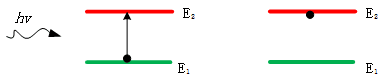
Figure 1. shows the process of stimulated absorption. As the particle absorbs the photon hv, it jumps from E1 to E2
- Spontaneous Radiation: After absorption, the particle is in an excited high-energy state, which is inherently unstable, like a ball perched on a hill, naturally inclined to roll down. Without any external influence, the particle can spontaneously transition back to the lower energy state, emitting a photon with energy E2−E1 and frequency v = (E2−E1)/h. This emitted light lacks coherence in phase, polarization, and direction, and thus is not laser light. Fluorescence is a common example of spontaneous emission.
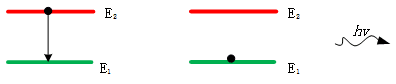
Figure 2. shows the process of spontaneous radiation, the excited particle is unstable and jumps down from E2 to E1, releasing a photon hv.
- Stimulated Radiation: Before spontaneous emission occurs, if an excited atom is struck by another photon of energy hV = E2 - E1 of the external photon induced action, it is possible to jump from the high-energy state to the low-energy state. The particle may be stimulated to transition down to the lower energy level, emitting a new photon identical to the incoming photon in wavelength, phase, polarization, and direction. This is the emission of the new photon is called stimulated emission. And we can see from this process that the number of photons has doubled. Repeating this process results in an exponential increase in identical photons — this is light amplification, and the resulting beam is laser light.

Figure 3. shows the process of stimulated radiation. the excited particle at a higher energy level is struck by a photon, and the particle emits another identical photon, so now the number of photons is doubled.
For laser generation, one crucial condition must be met: optical gain must exceed absorption, meaning that stimulated emission must outweigh stimulated absorption. This requires a phenomenon known as population inversion.
3) Population Inversion
Under normal thermal equilibrium, the distribution of atoms across energy levels follows the Boltzmann distribution, meaning far fewer atoms occupy higher energy levels compared to lower ones. As a result, absorption typically dominates over emission, preventing light amplification. To reverse this, a population inversion must be achieved, where more atoms reside in the higher energy state than in the lower one.
Achieving this requires two key components:
- Laser Medium (or Gain Medium): This material must support the conditions for population inversion and must possess suitable energy level structures. External energy must be supplied to excite electrons into higher energy levels. This process is called “pumping,” and common methods include optical pumping, chemical pumping, and nuclear pumping.
- Metastable Energy Levels: Some atoms have high-energy states with relatively long lifetimes, known as metastable states. These states are more stable than ordinary excited states, allowing electrons to remain there long enough to be stimulated by incoming photons rather than decaying spontaneously. This increases the likelihood of stimulated emission.
The process works as follows:
- Electrons in the ground state are excited to a higher energy level through pumping.
- From the excited state, they quickly drop to a metastable state instead of returning directly to the ground state.
- Over time, more and more electrons accumulate in the metastable state, creating a population inversion. When stimulated by light, these electrons produce strong, coherent light — the laser beam.
Lasers featuring ground, excited, and metastable states are referred to as three-level lasers (e.g., ruby lasers). Lasers with two metastable states are known as four-level lasers (e.g., Nd:YAG lasers).
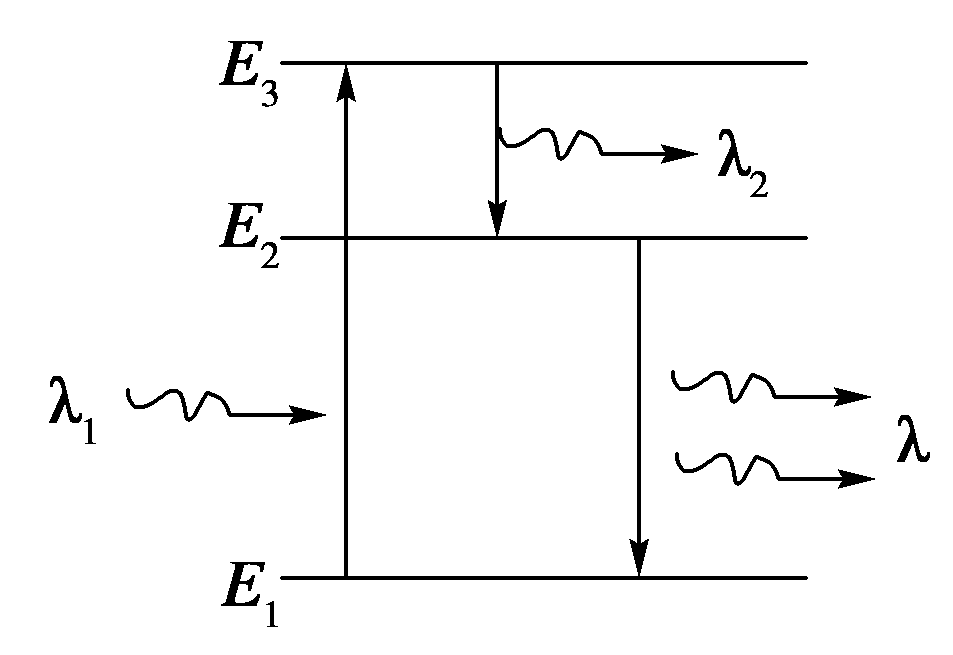
Figure 4. shows how a three-level laser achieves stimulated emission
4) The Properties of Lasers — What Makes Them So Useful?
- Coherence: Due to stimulated emission, all emitted photons are identical in wavelength, phase, polarization, and direction. This results in both temporal and spatial coherence. Coherence ensures that photons do not interfere destructively, enabling the creation of high-intensity beams.
- Narrow Bandwidth: Lasers typically have an extremely narrow wavelength range — often considered monochromatic — the emission wavelength is determined by the gain medium.
- Collimated Light: Laser beams exhibit minimal divergence, with a highly directional propagation.
- High Intensity: Photon populations can grow exponentially, resulting in beams of extremely high power. This is why lasers can be useful for many applications requiring high energies, such as laser cutting, laser medical surgeries.
5) Laser Resonators
Most laser systems achieve light amplification and emission through a laser resonator or a laser cavity. The most basic side-pumped solid-state laser resonator consists of a gain medium placed between two mirrors — one highly reflective mirror and one partially reflective output coupler. With side-mounted pump lamps, this configuration forms a fundamental laser emission system.
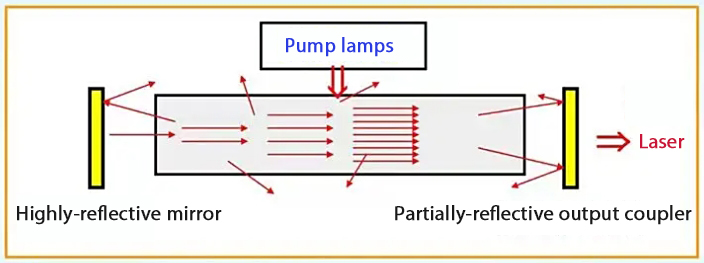
Figure 5. Laser resonator
Each component plays a distinct role:
- Pumping Source: The laser pump supplies energy to excite electrons in the gain medium to the higher energy metastable state, realizing population inversion, preparing for stimulated emission, hence ensuring the proper condition for laser generation. Common pumping methods include optical, chemical, and electrical pumping. Ruby lasers are excited by lamp excitation, and HeNe lasers are excited by gas discharge.
- Gain Medium: The laser gain media, such as laser crystals, have unique energy level structures that allow them to produce photons and amplify the beam. The role of the media is to provide the particles that duplicate the photons.
- High Reflector & Output Coupler: The HR mirror and OC mirrors allow photons to bounce back and forth through the gain medium, triggering avalanche amplification of light and exponential photon multiplication while controlling the output.
About Shalom EO
Hangzhou Shalom EO is a specialized supplier of laser optics. our product catalogue is broad, including various laser crystals, laser HR mirrors, laser output couplers, and femtosecond laser optics.
In the next lesson, engineers from Shalom EO will explore the structure of laser resonators and the principles of laser longitudinal modes in depth. Be sure to bookmark and follow for updates.