

Gadolinium Oxysulfide Scintillator: Material, Mechanism, Design
Overview: Gadolinium Oxysulfide Scintillator: Material Engineering, Emission Mechanism, and Detector Integration
Gadolinium oxysulfide scintillator (Gd2O2S) is a high-density rare-earth ceramic material for X-ray and gamma-ray detection. This article analyzes Pr- and Tb-activated GOS ceramics, thin films and pixelated arrays, covering luminescence physics, sintering technology, emission characteristics (512–550 nm) and integration with silicon photodetectors in medical, industrial and security imaging systems.
You might also be interested in our previous articles:
- GOS Ceramics: A Comprehensive Guide: which provides a general tutorial on GOS ceramics
Article Guide:
- Part 1. Pr doped Gadolinium Oxysulfide
- Part 2: Tb doped Gadolinium Oxysulfide
- Part 3: Pr: Gadolinium Oxysulfide Thin Films and Tb: Gadolinium Oxysulfide Pixelated Arrays
Part 1: Praseodymium-doped Gadolinium Oxysulfide Scintillator
Product Name: Praseodymium-doped Gadolinium Oxysulfide Ceramic
Chemical Formula: Pr:GOS (Gd₂O₂S:Pr)
Material Composition: Ceramic material
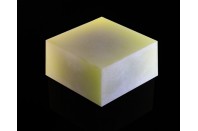
Reference Product Image:
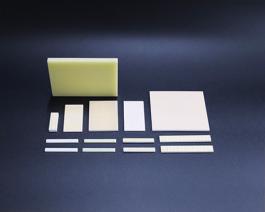
I. Product Overview
Praseodymium-doped gadolinium oxysulfide (Pr: GOS) scintillator is a widely used scintillator material—a functional material capable of converting high-energy radiation such as X-rays and gamma rays into ultraviolet or visible light. By detecting the fluorescence emitted when the material is irradiated with X-rays, gamma rays, or other ionizing radiation, information regarding the incident radiation can be obtained.
Pr:GOS scintillator ceramics exhibit several advantageous properties, including high light yield, short afterglow, excellent radiation stability, superior optical transparency, and non-hygroscopicity. These characteristics make them suitable for diverse applications such as container inspection and security screening, medical imaging modalities (including PET, SPECT, and CT), and industrial non-destructive testing (NDT) systems.
The manufacturing process begins with calcining raw materials—gadolinium oxide, sulfuric acid, and praseodymium oxide—to synthesize Pr:GOS powder. This powder is then sintered at high temperatures to form dense Pr:GOS ceramic scintillators. Subsequently, the ceramic is cut and precision-polished according to customer specifications to achieve high surface quality and dimensional accuracy.
II. Operating Principle
Under irradiation by X-rays, gamma rays, or other forms of ionizing radiation, Pr:GOS ceramic emits fluorescence with a peak emission wavelength of approximately 512 nm. This luminescent signal is converted into an electrical signal using silicon photodiodes or silicon photomultipliers (SiPMs). The resulting electrical signal can then be processed and analyzed to extract information about the incident radiation, thereby enabling detection and imaging.
In practical applications, Pr:GOS ceramics are typically fabricated into pixelated arrays. Such structured scintillator arrays facilitate high-resolution imaging in medical diagnostics, security screening, and industrial non-destructive evaluation.
III. Manufacturing Process
Ceramic Fabrication:
Powder Synthesis: Gadolinium oxide, sulfuric acid, and praseodymium oxide are mixed and calcined to produce Pr:GOS phosphor powder.
Sintering: The synthesized Pr:GOS powder is compacted and sintered at elevated temperatures to form a dense, transparent ceramic scintillator body through solid-state reaction.
Precision Machining:
The sintered ceramic is cut to specified dimensions and undergoes parallelization, fine grinding, and optical-grade polishing to ensure stringent control over surface flatness and finish quality.
Scintillator Array Fabrication:
To fabricate pixelated scintillator arrays, the ceramic is segmented into individual pixel elements according to design requirements. These pixels are arranged in one- or two-dimensional configurations, separated by reflective layers to minimize optical crosstalk, and bonded together using optical adhesive followed by curing.
Inspection and Packaging:
Finished products undergo rigorous inspection for dimensional accuracy, parallelism, and surface quality against defined specifications. Final packaging is performed in a cleanroom environment to maintain product integrity.
IV. Application Fields
- Pr:GOS ceramics are extensively employed in X-ray–based technologies, including:
- Security and baggage inspection systems
- Medical imaging equipment (e.g., PET, SPECT, and CT scanners)
- Industrial non-destructive testing (NDT) devices
Part 2: Terbium-doped Gadolinium Oxysulfide
Product Name: Terbium-doped Gadolinium Oxysulfide Ceramic
Chemical Formula: Tb:GOS (Gd₂O₂S:Tb)
Material Type: Ceramic
Reference Product Image:
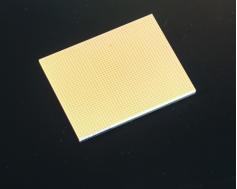
I. Product Introduction
Terbium-doped gadolinium oxysulfide (Tb:GOS) scintillator is a widely used scintillator material—a functional material capable of converting high-energy radiation such as X-rays and gamma rays into ultraviolet or visible light. When exposed to X-rays, gamma rays, or other ionizing radiation, Tb:GOS emits fluorescence, enabling detection and imaging of the incident radiation.
Tb:GOS scintillator ceramics offer several key advantages, including high light yield, short afterglow, excellent radiation hardness, superior optical transparency, and non-hygroscopic properties. These characteristics make them suitable for a broad range of applications, including container inspection systems for security screening, medical imaging modalities (such as PET, SPECT, and CT), and industrial non-destructive testing (NDT) equipment.
The manufacturing process begins with calcining raw materials—gadolinium oxide, sulfuric acid, and terbium oxide—to synthesize Tb:GOS phosphor powder. This powder is then sintered at high temperatures to form dense Tb:GOS ceramic scintillators. Finally, the ceramic is precision-cut and optically polished to meet customer-specific dimensional and surface quality requirements.
II. Operating Principle
Under irradiation by X-rays, gamma rays, or other forms of ionizing radiation, Tb:GOS ceramic emits fluorescence with a peak emission wavelength of approximately 512 nm. This luminescent signal is detected and converted into an electrical signal using silicon photodiodes or silicon photomultipliers (SiPMs). Subsequent signal processing allows extraction of information about the incident radiation, thereby achieving detection and imaging objectives.
In practical implementations, Tb:GOS ceramics are typically fabricated into pixelated arrays. Such structured scintillator arrays enable high-resolution imaging in medical diagnostics, security screening, and industrial non-destructive evaluation.
III. Manufacturing Process
Ceramic Fabrication:
Powder Synthesis: Gadolinium oxide, sulfuric acid, and terbium oxide are mixed and calcined to produce Tb:GOS phosphor powder.
Sintering: The synthesized Tb:GOS powder is compacted and sintered at elevated temperatures to form a dense, transparent ceramic scintillator through solid-state reaction.
Precision Machining:
The sintered ceramic is cut to specified dimensions and undergoes parallelization, fine grinding, and optical-grade polishing to ensure stringent control over surface flatness and finish quality.
Scintillator Array Fabrication:
To fabricate pixelated scintillator arrays, the ceramic is segmented into individual pixel elements according to design requirements. These pixels are arranged in one- or two-dimensional configurations, separated by reflective layers to minimize optical crosstalk, and bonded together using optical adhesive followed by curing.
Inspection and Packaging:
Finished products undergo rigorous inspection for dimensional accuracy, parallelism, and surface quality against defined specifications. Final packaging is performed in a cleanroom environment to maintain product integrity.
IV. Application Fields
Tb:GOS scintillators are extensively used in various X-ray imaging systems, including:
- Security screening equipment (e.g., baggage and cargo scanners)
- Medical X-ray imaging devices, such as PET and CT scanners
- Industrial non-destructive testing (NDT) systems
Part 3: Shalom EO offers Scintillator Component Made of Gadolinium oxysulfide
- Terbium-doped Gadolinium Oxysulfide Thin Film
Terbium-doped gadolinium oxysulfide thin film—commonly abbreviated as GOS (Gd₂O₂S:Tb)—consists of three functional layers: a protective layer, a GOS phosphor layer, and a substrate. GOS (Gd₂O₂S:Tb) is a high-performance scintillator material widely employed in medical imaging (e.g., digital radiography/DR), industrial non-destructive testing (NDT), and high-energy physics experiments due to its exceptional X-ray conversion efficiency and stable optical characteristics.
Key advantages include its high density (7.34 g/cm³) and high effective atomic number (Gd: Z = 64), enabling efficient X-ray absorption and conversion into green visible light centered at ~550 nm—optimally matched to silicon-based photodetectors such as CCD or CMOS sensors.

Phosphor Layer Composition (Gd₂O₂S:Tb):
Gadolinium (Gd): 82.2%
Oxygen (O): 8.4%
Sulfur (S): 8.4%
Terbium (Tb): 1.0%
The phosphor layer thickness typically ranges from 5 μm to 500 μm, with standard operational thicknesses between 150 μm and 350 μm.
II. Film Structure
Protective Layer: 15 μm PET (polyethylene terephthalate) film offering high optical transparency and scratch resistance. An optional anti-static coating may be applied to minimize dust adhesion.
Phosphor Layer: Composed of Gd₂O₂S:Tb, where Tb³⁺ acts as the luminescent activator. Green emission at 550 nm arises from the ⁵D₄ → ⁷F₅ radiative transition of Tb³⁺ ions. Standard thickness: 150–350 μm.
Substrate: 150 μm PET film featuring low autofluorescence and excellent mechanical flexibility, compatible with roll-to-roll manufacturing processes.
Adhesive (Optional): Epoxy- or silicone-based bonding agents, selected for high-temperature stability and low outgassing properties.
III. Manufacturing Process
- Powder Synthesis: Co-precipitation method is used to precisely control the Gd/Tb molar ratio, ensuring compositional homogeneity. Tb³⁺ doping concentration is typically optimized within 0.1–1.0 mol% to maximize luminescence efficiency.
- Sintering: Performed under a reducing atmosphere (e.g., H₂S) at 1400–1600°C to form the pure Gd₂O₂S crystalline phase. Particle size is controlled to 5–20 μm to minimize light scattering losses.
- Film Formation: Achieved via hot pressing (10–20 MPa, 150–200°C) or tape casting, yielding a phosphor layer with >95% of theoretical density.
- Lamination & Encapsulation: Vacuum lamination eliminates interfacial voids; UV-curable coatings enhance adhesion between the protective layer and phosphor.
IV. Operating Principle
The GOS (Gd₂O₂S:Tb) thin film functions as a high-efficiency X-ray scintillator through a multi-step energy conversion process:
Incident X-rays are strongly absorbed by high-Z gadolinium atoms via the photoelectric effect, generating electron-hole pairs.
This energy migrates through the crystal lattice and is transferred to Tb³⁺ activator ions, exciting them to the ⁵D₄ energy level.
Radiative decay from ⁵D₄ → ⁷F₅ produces bright green fluorescence at 550 nm, with a high light yield of approximately 60,000 photons/MeV.
The emitted light transmits through the 15 μm PET protective layer and is captured by a downstream silicon photodetector (e.g., CMOS/CCD), which converts it into an electrical signal for image reconstruction.
By adjusting the phosphor layer thickness (150–350 μm), the film balances spatial resolution (3.5–5 lp/mm) and detection sensitivity. Its 550 nm emission peak aligns perfectly with the spectral response of silicon sensors. Additional benefits include non-hygroscopicity and resistance to radiation-induced degradation, making it a core detection material in medical DR systems and industrial CT scanners.
V. Common Applications
- Medical Imaging: Dynamic DR systems (e.g., gastrointestinal fluoroscopy units), dental panoramic X-ray machines (using high-resolution variants such as DRZ-STD).
- Industrial NDT: Inspection of aerospace composite materials; defect detection in lithium-ion battery electrode foils. Custom ultra-thin substrates (e.g., 100 μm PET) enable deployment in confined spaces.
- Security Screening: Used as a low-energy X-ray detection module in dual-energy baggage scanners, often paired with CsI(Tl) arrays (for high-energy detection) to enable material discrimination.
- Praseodymium-doped Gadolinium Oxysulfide Ceramic Array
I. Product Overview
Praseodymium-doped gadolinium oxysulfide ceramic array (Pr:GOS) is a high-density rare-earth oxysulfide ceramic material specifically engineered for photodetection and scintillation applications. It is fabricated by high-temperature sintering of high-purity Gd₂O₂S crystals doped with Pr³⁺ ions, forming an ordered array of ceramic pixel elements. This structure ensures exceptional optical uniformity across the array.
The incorporation of Pr³⁺ ions endows the material with excellent photoluminescent properties, enabling rapid emission of visible light upon excitation by short-wavelength, high-energy photons. The resulting product features high light output, fast response time, and robust mechanical and thermal stability.
As illustrated in the accompanying schematic, the Pr:GOS ceramic array adopts a cubic geometry composed of regularly arranged ceramic pixel strips. Each yellow square represents an individual pixel element—corresponding to one detection channel—that enables precise spatial acquisition of optical signals. The white regions denote optical reflector layers, which serve to guide and enhance fluorescence extraction, thereby improving optical efficiency and signal-to-noise ratio. This design ensures high material density, mechanical integrity, thermal stability, and optical homogeneity.
Note in original figure caption: The large cube depicts the Pr:GOS array; the yellow sub-elements represent individual scintillator pixels (erroneously labeled as Ce:GAGG in the original Chinese text); the white areas indicate optical reflector layers.
II. Operating Principle
Upon exposure to high-energy photons or electrons, Pr³⁺ ions within the GOS matrix absorb energy and undergo electronic transitions, subsequently emitting fluorescence in the visible spectrum (approximately 520–540 nm). This process enables rapid and efficient conversion of incident radiation into detectable optical signals.
The pixelated array architecture optimizes light propagation paths, enhancing both optical collection efficiency and spatial resolution. As a polycrystalline ceramic, the material exhibits high optical uniformity, ensuring stable, reproducible signal output across all pixels.
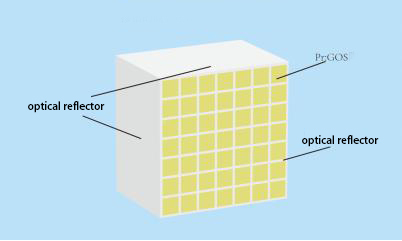
As shown in the figure above: The large cube represents a Pr:GOS array, where the small yellow squares denote individual Pr:GOS crystal bars—each corresponding to a single pixel—while the white sections indicate the optical reflection layer.
III. Manufacturing Process
The production follows standard optical ceramic fabrication protocols, comprising the following key steps:
- Raw Material Preparation: High-purity precursor powders are synthesized and thoroughly homogenized.
- Sintering: The mixed powder is densified under high temperature in an argon atmosphere to preserve stoichiometry and ensure uniform Pr³⁺ distribution.
- Precision Machining: The sintered block undergoes precision grinding and optical polishing to achieve flat, low-scatter surfaces that maximize light transmission and extraction efficiency.
- Array Assembly & Reflector Integration: Individual pixel elements are formed and separated by highly reflective interlayers to minimize optical crosstalk.
- Final Inspection & Packaging: Each batch undergoes rigorous testing for optical performance, mechanical strength, and thermal stability to guarantee consistent quality and reliability.
Application Fields
Pr:GOS ceramic arrays are widely deployed in scientific research and industrial optical systems, including:
- Laboratory-based optical detection setups
- X-ray and gamma-ray scintillation detectors
- Industrial optical imaging and sensor systems
- Integrated laser optics and photodetector modules
Thanks to their high luminous efficacy and rapid temporal response, these arrays excel in high-precision optical measurement and imaging applications.
Related Articles
Related Products
 Array-198x131.jpg "GOS:Tb Scintillator Array")

Tags: Gadolinium Oxysulfide Scintillator: Material Engineering, Emission Mechanism and Detector Integration